 the high tide produced by the moon.
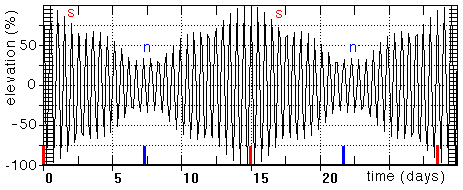
This figure shows the tide that results from the combined movement of earth, moon and sun seen in the animation of the last page. Note that the tidal range is particularly large at days 0 and 15 and
particularly small at days 7 and 22. The reason for this was seen in the animation: At days 0 and 15 the major axes of the tide generating potentials of moon and sun are aligned with each other, so the high tide produced by the sun is added to
the high tide produced by the moon.
We worked out previously that the magnitude of the tide generating potential of the sun is about 46% of the magnitude of the tide generating potential of the moon. What this means is that the tide produced by the moon is increased during spring tide by 46%. At days 7 and 22 high tide from the moon's potential occurs at the same time when the sun produces a low tide; the tidal range is therefore reduced by 46%.
The result is a fortnightly variation of the tidal range between 146% and 54% of the mean range known as the fortnightly tidal inequality. The figure shows this as a variation normalized with respect to spring tide, so it shows 100% for spring tide and 27% for neap tide.
The figure shows the tide under the assumption that the form factor at your home location (or closest beach) is equal to zero, in other words that the tide in that location does not have a diurnal component; it is purely semidiurnal. You can verify this by counting the number of high tides between successive neap tides; between days 7 and 22 you should count 28 high waters. Some places on earth have tides resembling this tide closely. Others have tides that look very different. The next page will follow this up.
 |
 |
 © 2000 M. Tomczak