
Remember, the sun is on the right (as indicated by the orientation of the illuminated side of the moon).
At day zero the moon's position relative to the earth is on the opposite side of the sun. Its illuminated side faces the earth, so it is fully visible; in other words, we have full moon.
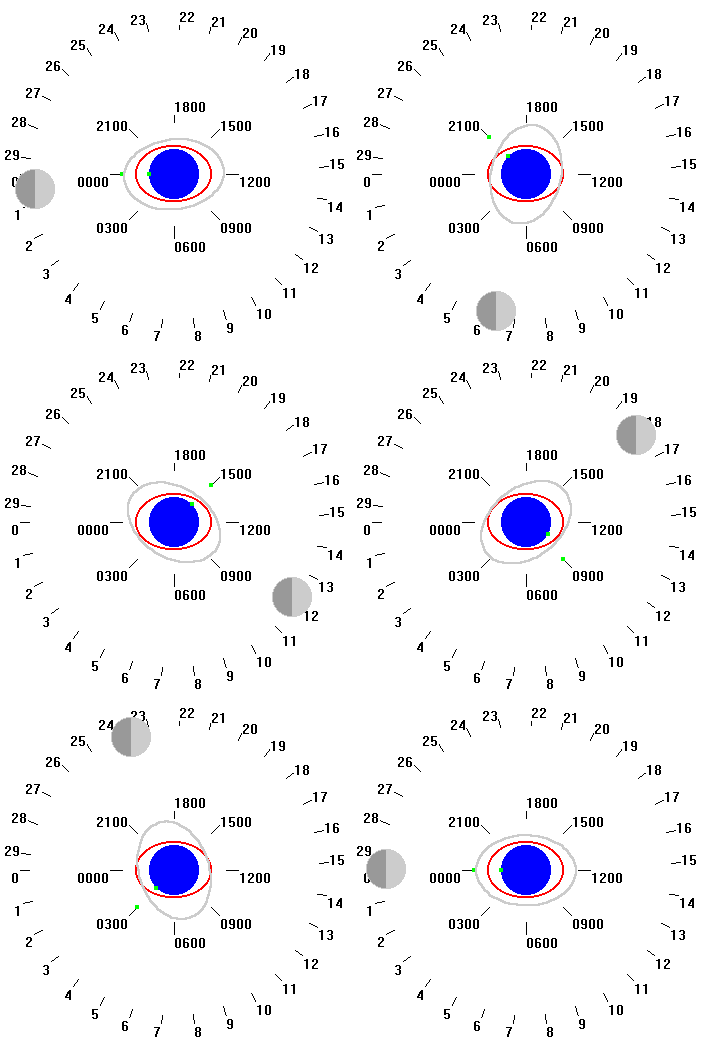
After 14 days the moon is between the sun and the earth, so its illuminated side faces away from the earth; we then have new moon. Third and first quarter are reached after 7 days and 22 days, respectively, when one half of the moon's illuminated side is visible from earth.
The animation proceeds in steps of 3 lunar hours, indicated by the movement of the green dots (your home town or closest beach). To emphasise the principal phases of the moon, the animation stops briefly at third quarter, new moon, first quarter and full moon.
The tide at your home location or closest beach is determined by the sum of the moon's and sun's contributions. Follow the green dots to see how the sum varies as the earth rotates: At some times, the contribution from the grey ellipse is large, while the contribution from the red ellipse is small. At other times it is the other way round.
The four lunar quarters are of particular significance. At full moon and at new moon the sum of both ellipses is the largest it can ever get at 00.00h and at 12.00h, while it is as small as it can ever get at 06.00h and 18.00h. This means that the difference between high tide at 00.00h and at 12.00h and low tide at 06.00h and 18.00h is very large. This situation is called a spring tide.
At third and first quarter the situation is quite different. At 00.00h and at 12.00h the contribution from the sun (the red ellipse) is largest but the contribution from the moon (the grey ellipse) is smallest. (Verify this when the moon stops briefly at these positions.) At 06.00h and 18.00h the situation is reversed; now the contribution from the sun is smallest but the contribution from the moon is largest. (Verify this.) As a result, the sum of the two contributions does not vary much over the day, and the resulting tide is relatively small. This situation is called a neap tide.
One major result of the interplay between the moon and the sun is thus a continuous change from spring tide to neap tide back to spring tide and so on forever, or expressed in other words, a periodic variation of the tidal amplitude from large tides "at springs" to small tides "at neaps". Can you figure out from the animation what the period of this change (the tmie span between successive spring tides) is?
animation based on Wintides by Peter L. Guth
 © 2000 M. Tomczak